.svg)






AdWall for the Fashion Industry: How to Plan a Collection or Sale Promotion
Shoppers have long since learned to tune out standard banners. With AdWall, the user chooses to engage with the ad, and Fusify helps extend that contact along the path to purchase.
.png)
TL;DR
- AdWall works on the principle of a voluntary exchange: the reader consciously agrees to watch a short ad in return for access to content, giving the brand a deliberate, attentive contact.
- Our ad formats adapt easily to specific goals. Video conveys the aesthetic of a new collection, static banners communicate a discount quickly, and Rich Media lets users flip through a lookbook.
- In the Modivo case, AdWall delivered 97% viewability and a 7.3% CTR, becoming the main engagement driver.
- For SOLO for Diamonds, the AdWall CTR exceeded 8%. The full multi-format campaign reached over 2.3 million users.
- Our team handles creative development, publisher selection, targeting, and real-time ad delivery optimization.
An eye-tracking study by Nielsen Norman Group includes a telling example. A user scrolls through a page on a smartphone, passing two Nordstrom ads. The banners enter the user’s field of vision, but the user keeps reading without paying attention to them. We explore why people ignore ads even when they are right in front of them in our article on banner blindness.
For the fashion industry, this is an especially sensitive issue, because visuals and striking imagery directly influence a shopper's desire to buy. Brands invest heavily in creatives to make customers want to try on the look they are shown. But if the shopper subconsciously ignores the ad, all that work goes unnoticed.
AdWall builds engagement on a transparent exchange. A person agrees to watch an ad in order to get full access to an article, so their motivation is clear and their attention is highly focused. It is one of the formats Fusify uses to promote fashion brands.
Let's walk through how to plan an AdWall campaign if you are launching a new collection or running a seasonal sale.
What AdWall Is and How It Works for Fashion Brands
AdWall can be used in fashion advertising to launch new collections, promote seasonal sales, and feature individual products. You can read more about how AdWall works in our dedicated article.
The reader starts the ad themselves to continue reading, while the brand uses that moment to showcase a new collection or a promotional offer. In such placements, ad viewability can reach 100% and CTR can reach 10%.
Here, we'll focus on what it offers fashion advertisers.
- AdWall helps present a fashion collection in a visual context.
A creative can show the collection in motion and combine items into complete outfits, making it easier for shoppers to picture them on themselves. Baymard research shows that standard photos on a white background are often not enough: during usability testing of the Puma website, one participant dropped a pair of sweatpants she had initially liked simply because she couldn't find a photo of them on a model.
- AdWall displays ads without other ad formats alongside them.
AdWall opens in a separate window over the article. While it plays, your collection photos and videos don't share the space with other advertisers' banners.
- The user opts in to watch the ad.
In a rewarded scenario, the reader starts the ad themselves to unlock the content. They understand what they get in return for watching, and this voluntary exchange can foster a more favorable attitude toward the brand's advertising.
- AdWall can be combined with retargeting after the initial interaction.
The first touchpoint is easy to reinforce with follow-up retargeting. With Fusify Pixel, you can track user actions in the online store itself. For example, if a user visited the coats section after seeing an ad for your autumn collection, the next ad should show them a selection from that very category.
Which AdWall Format to Choose for a Fashion Campaign: Video, Static Banner, or Rich Media
At Fusify, we provide the technical preparation and support for ad placements in AdWall. You can run static banners, video ads, or interactive Rich Media formats developed by our team.
The choice of creative depends on your campaign goals. Let's look at what each option offers so you can decide which suits you best.
When to Use Video in AdWall for Fashion Advertising
Video remains the most effective way to convey the movement of fabric, the cut, the fit of garments, and the aesthetic of a brand.
Use cases:
- When launching a new collection, show several looks in the video that best capture its mood.
- In a brand image campaign, tell the story of how the collection was created, whether through a conversation with the designer or footage from the atelier.
- When promoting a single item, suggest what to pair it with, for example, how your brand's coat can be styled with a suit or with jeans.
What to keep in mind during production:
- In the first seconds, show the item in motion or a complete look, and add the brand name. Viewers should immediately understand what is being offered, even if they don't watch to the end.
- Adapt the video to vertical and square formats. Since the lion's share of fashion traffic comes from smartphones, the video should fill the mobile screen cleanly, without black bars or distortion.
- The button leading to the store should remain visible throughout playback.
When to Use a Static Banner in AdWall: Sales and Individual Products
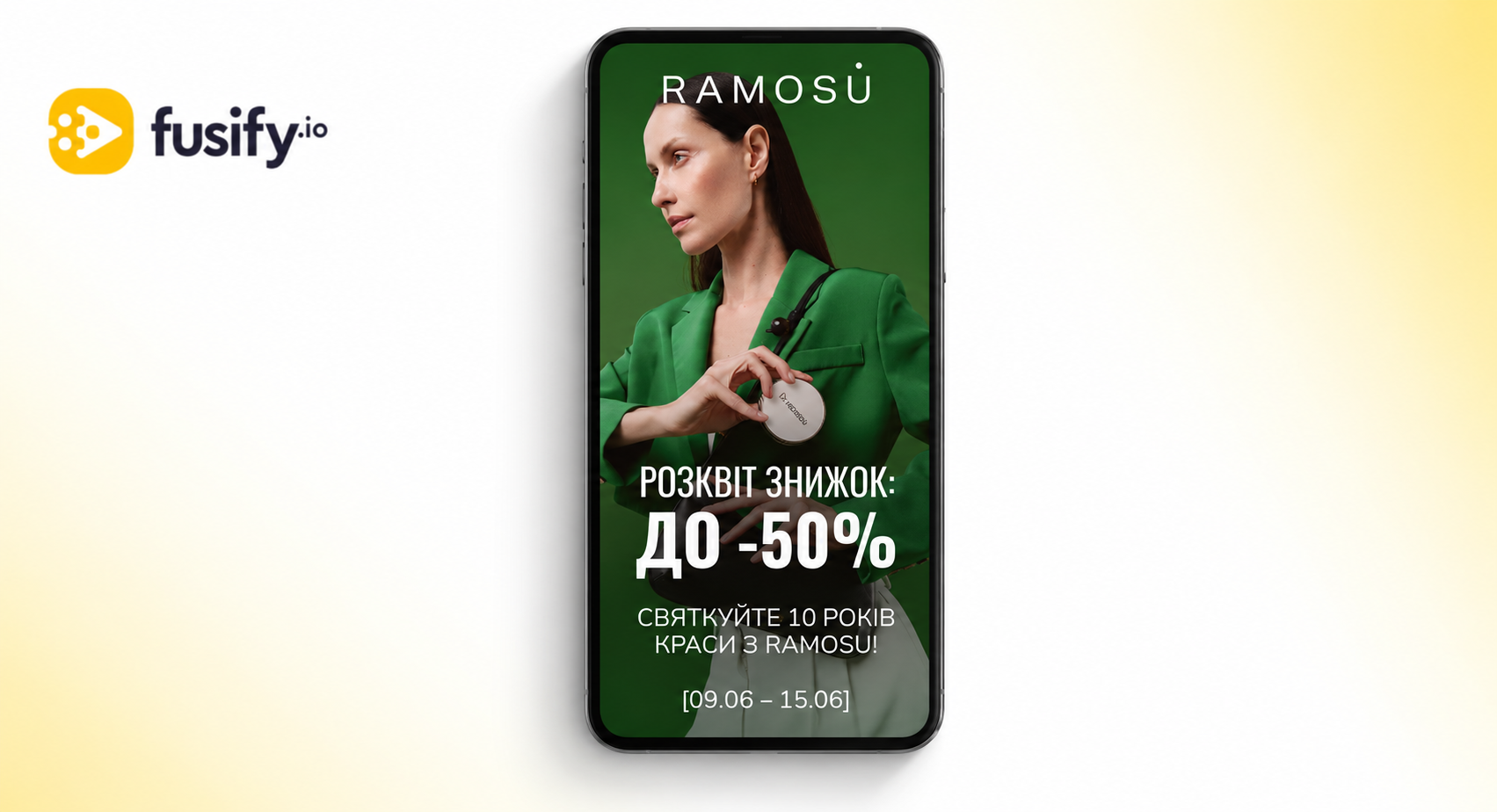
A static banner combines a product photo, a short message, and a call to action to visit the store. The format works well when the key message needs to be delivered in a single frame.
Use cases:
- During a sale, show the discounted items, the size of the discount, and the offer period.
- To promote a specific item, build the layout around a photo of the product on a model. This works when the campaign is dedicated to a new arrival or a bestseller.
- To announce a collection or collaboration, use the campaign's key visual, its name, and an invitation to browse the new pieces.
How to get the maximum effect:
- Use shots with models instead of lifeless photos of items on a white background. People should see right away how the item fits and looks on a body.
- Don't overload the banner with text. Keep only the brand name, a short offer, and a prominent button, because small print on a mobile screen will simply be scrolled past.
- Make sure the image has high contrast and a clear focus. The clothing should remain the main element of the composition, with the background only emphasizing the colors and texture.
- Keep the call to action prominent and clear. The button text should clearly suggest the next step, such as going to the catalog or claiming the discount.
When to Use Rich Media in AdWall: Lookbooks, Catalogs, and Interactive Mechanics
Fusify Rich Media are interactive ad formats developed by our team. They can combine animation, video, image galleries, and game mechanics. Users interact with them directly in the ad: they flip through products, select elements in an image, or perform simple actions to explore the offer.
Flipbook
In a Flipbook, images change with a page-turning effect, as in a printed magazine. The reader flips through the creative themselves, looking at the photos and their captions.
To launch a new collection, you can put together a small advertising lookbook. If you are promoting one specific item, show several ways to style it. For example, how the same jacket looks with jeans, a skirt, or classic trousers.
Carousel
A Carousel holds up to ten product cards in a single ad. The user swipes through the cards and looks at the items more closely, and if needed, you can add a separate link for each card leading directly to the corresponding product page.
During a sale, put together a selection of products with promotional prices. For example, several models of boots or bags. Another option is to dedicate each card to a category: coats, knitwear, footwear.
Showcase
In a Showcase, you show a complete look in a single frame and add interactive dots next to each item. A person clicks on a marker and immediately sees the details and price of that specific item without leaving the ad block. This lets them examine all the components of the look directly in the ad.
This approach takes into account the shopper behavior described by Baymard. A photo of a complete look often draws attention to several items in the frame at once. Researchers observed that people regularly became disappointed and left the site when they couldn't quickly find a specific piece of clothing they liked in the photo.
If you have a shoot with ready-made styling, this format is the best fit. Add markers next to the trousers, shoes, and bag, each with a short description and a link. The shopper sees how the items go together and can click through to the one they like.
Scratch
Scratch consists of two layers. First, the user sees an image with an invitation to erase the coating. By swiping a finger or cursor across it, they gradually reveal the content underneath, for example a photo of a new arrival or a promo code.
For a sale, you can prepare an ad that says "Reveal a promo code for an extra discount."
AdWall Results in Fashion and Retail: The Modivo and SOLO for Diamonds Cases
We have put together two recent Fusify cases: Modivo and SOLO for Diamonds. Using them as examples, we'll look at how AdWall works in combination with other ad formats, what results brands get, and what is worth taking from this experience when planning your own campaign.
Modivo Case: 97% Viewability and 7.3% CTR for AdWall Video
In the campaign for the retailer Modivo, we worked on increasing brand awareness and attracting a new audience in Ukraine. Our team tested three different tools within a single launch: AdWall Video, Banner Slider, and Brander.
Ad viewability for AdWall reached 97%. AdWall had the highest CTR of the three formats used, at 7.3%, while Banner Slider and Brander helped expand reach.
This is an important conclusion for media planning, since maximum engagement and the widest reach often come from different tools. Combining formats lets you build brand awareness and get quality traffic at the same time.
SOLO for Diamonds Case: Over 8% AdWall CTR and 2.3 Million Campaign Reach
For the jewelry brand SOLO for Diamonds, we built a systematic presence in the regions of Ukraine and created deferred demand. In the premium segment, a purchase rarely happens on the first click, so the strategy involved a series of sequential contacts.
We combined AdWall, Rich Media, Mobile Brander, and Half-screen. We tested a broad audience aged 35–55, users interested in travel, finance, and premium goods, and a business segment. We prepared more than 20 visuals for the different formats and updated the creatives regularly.
Campaign results:
- The AdWall CTR exceeded 8%.
- The total reach across all formats was over 2.3 million users.
- An audience was built for further remarketing, and post-view analysis was set up to track deferred conversions.
This case is an example of consistent work with a high-ticket purchase. Testing audiences, preparing a series of creatives, and setting aside a remarketing budget in advance are essential steps when the buyer needs time to decide.
Which KPIs to Use to Evaluate an AdWall Campaign
AdWall has one of the highest CTRs among Fusify formats, but it may fall behind other placements in reach. In a rewarded scenario, the ad is seen by readers who have agreed to watch it, so the available audience is narrower. If the goal of the campaign is to introduce as many people as possible to the brand, you should add reach formats. AdWall's results should then be evaluated by how many clicks and orders it brought and how much they cost.
This is exactly the approach used in the Modivo campaign. AdWall can help build awareness, but a high CTR on its own doesn't show how well people remembered the brand.
How to read campaign results.
Why Run Fashion Campaigns with Fusify
Every month, the Fusify platform processes over 300 billion requests. This scale helps find the right audience more precisely and show ads at the moment when users are most inclined to buy. For more than 10 years, we have worked in the markets of Ukraine, Turkey, and Brazil, where we support over 1,000 campaigns every month.
What does an advertiser get from Fusify?
- Audience targeting and segmentation. Ads can be directed at new buyers, at site visitors, or at a similar audience using look-alike mechanics. For this, Fusify has ready-made and custom segments and remarketing. And more than 700 IAB categories let you show ads only on publishers that are relevant by topic.
- Smart Impressions for visibility control. If you combine AdWall with banner formats, Smart Impressions technology counts an impression only when the ad actually appears in the visible area of the screen.
- Fusify Pixel for conversion attribution after ad clicks and views. A person may see a coat in an ad but place the order only a few days later. Fusify Pixel helps link such an order to the earlier ad contact. It records conversions after a click on or view of the ad within the agreed attribution period.
- Real-time campaign analytics. More than 30 metrics are updated every five minutes. This lets you compare the performance of publishers, creatives, or segments and quickly adjust settings during the campaign. Data can be downloaded as CSV or XLSX or sent to your own analytics system via API.
Conclusion
AdWall brings back to fashion advertising what standard banners have lost: the shopper's conscious attention. To convert it into sales, it is worth planning the structure of your campaign in advance. Together with Fusify, choose the right creative format, combine AdWall with reach formats, and set aside a budget for retargeting those who have already shown interest.
Want to see how AdWall will work with your product range? Leave a request, and the Fusify team will prepare an interactive demo based on your visual materials.
.png)

.png)




.webp)
.webp)
.webp)

.webp)


.webp)

.webp)
.webp)

.webp)
.webp)

.webp)

.webp)

