



How Jewelry Brands Can Support Customers Through a Long Buying Cycle
People rarely buy expensive jewelry on impulse, so a campaign’s success depends on how well the brand supports shoppers throughout their decision-making process.


TL;DR
- Deferred demand calls for a flexible approach. People rarely buy jewelry straight away. They compare prices, weigh their options, or wait for a special occasion. Advertising should address what is holding them back and help them decide.
- Different messages need different ad formats. Choose formats that suit what you want to communicate at each stage of the buying journey.
- Stay in touch through retargeting, email, and user-generated content (UGC). Limit ad frequency and refresh your creatives.
- The SOLO for Diamonds campaign reached 1.6 million users per month and more than 2.3 million when scaled up. AdWall’s CTR exceeded 8%.
- Fusify Pixel helps connect later purchases to earlier ad clicks and impressions through post-click and post-view attribution.
Jewelry purchases often revolve around occasions such as holidays, anniversaries, and birthdays. Even then, buying is rarely impulsive, and choosing a piece can take weeks. Shoppers may compare a dozen similar designs, check prices, and take time to decide whether a piece is worth the money.
For a brand, this extended cycle calls for a completely different approach to communication. Aggressive sales pitches won't work when buyers simply need time. The campaign requires precise timing and tailored messaging for every single stage. Below, we break down how to handle deferred demand in the jewelry space effectively and how Fusify puts this into practice.
What Is Deferred Demand and Why Does It Require Adaptive Ad Strategies?
Deferred demand is a state where a consumer recognizes a need for a product or service but intentionally postpones the purchase. Common triggers include budget constraints, waiting for better deals, needing more details, or timing the buy to a specific event.
Jewelry is also often bought as a gift, which can make the choice harder. The buyer may be unsure about the recipient’s style or size, even when the price is attractive. Advice from a sales associate or reassurance that the piece can be returned may help them feel ready to buy.
Understanding why someone is waiting helps you choose the right advertising message:
- If the price is beyond their budget, show similarly designed pieces in a more affordable price range.
- If they are deciding between designs, explain the differences and offer help choosing or an opportunity to try them on.
- If the purchase is planned for a holiday or anniversary, remind them of the piece they chose as the date approaches. Include the order deadline so their gift arrives on time.
Even when buying jewelry for ourselves, we often wait for a special occasion. Mejuri has built its positioning around challenging that habit, presenting fine jewelry as something to wear and enjoy every day. In an interview with ELLE Canada, co-founder Noura Sakkijha explains that she wanted to encourage people to buy jewelry for themselves, whether or not they had an occasion in mind.
How to Advertise a Jewelry Brand at Each Stage of the Buying Journey
Buying fast-moving consumer goods (FMCG), such as shampoo, usually takes little thought. Shoppers know what they need, so a banner offering a good discount may be enough to prompt a purchase. With jewelry, a straightforward sales message is rarely enough. People may spend weeks looking for inspiration, comparing designs, or waiting for the right occasion. Their priorities change during that time, so repeating the same banner throughout the campaign makes little sense.
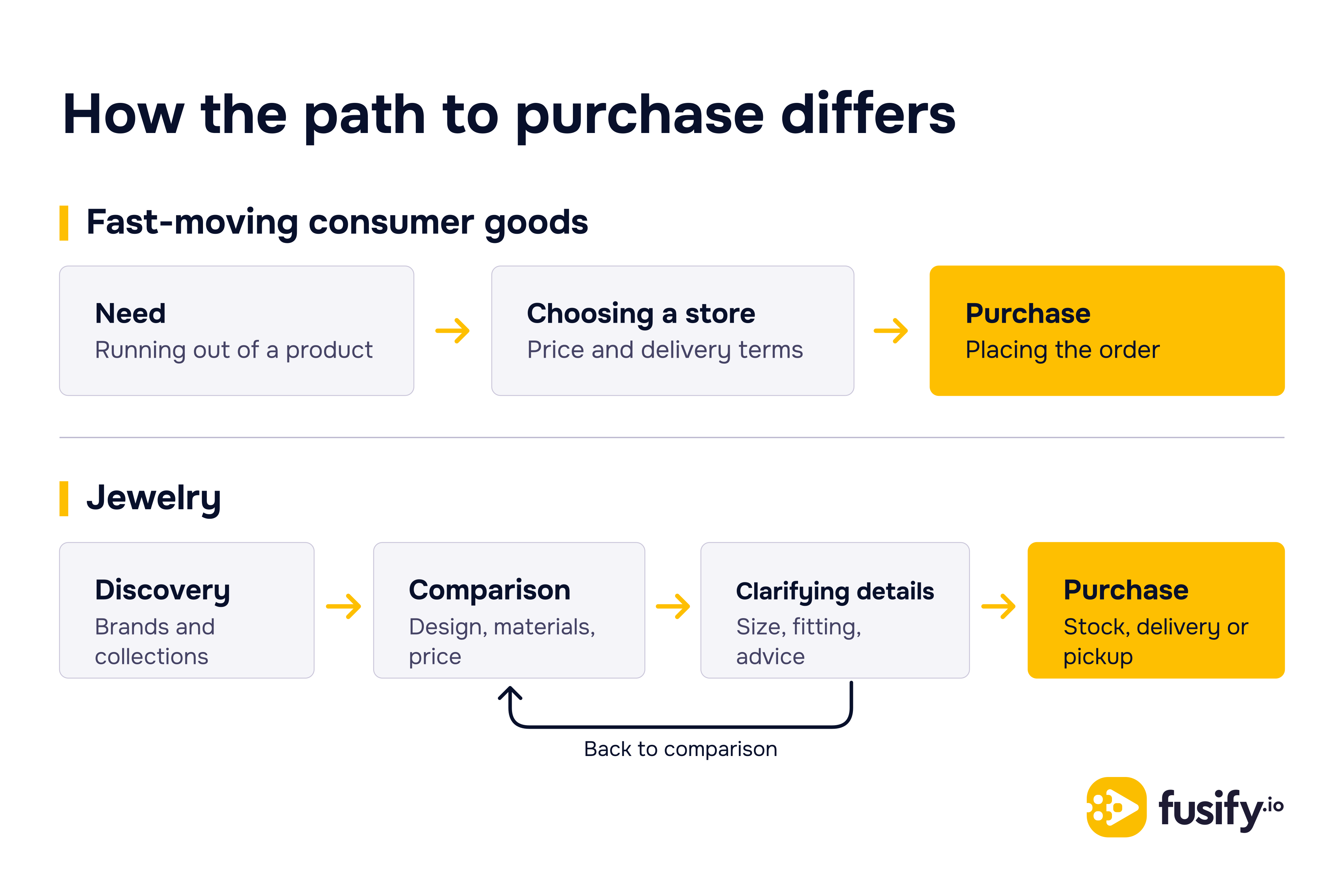
Pandora plans its holiday advertising around the fact that choosing jewelry takes time. “We know that our shoppers like to browse the web and social media before they purchase, so we zero in on reach first and foremost,” explains Peter Braher, Pandora’s paid and owned digital marketing lead for Australia and New Zealand, in Think with Google.
Early in the holiday campaign, Pandora focuses on storytelling to help shoppers connect with the brand. As they get closer to buying, ads provide practical information about availability, delivery, and returns. Once the holiday delivery deadline has passed, the ads help people find the piece they want in nearby stores.
The message changes as the shopper’s needs change. Here is how to choose messages and formats for each stage.
Getting to Know the Brand
At this stage, pushing for a purchase or leading with discounts is premature. People first need to fall in love with your brand and want to own one of your pieces.
Around New Year’s, for example, warm, heartfelt stories can work well. You could use Fusify’s Native Video to run a short film that sets a festive mood and introduces the collection.
Another option is a selection of beautifully styled images that people enjoy browsing. Fusify’s Carousel lets you bring together jewelry worn by models, combinations of pieces, or complete looks for different occasions.
Choosing a Piece
Once someone is interested in the brand, they need more information about the jewelry itself. Show the pieces up close, highlight the details, and give shoppers more specifics than you did when introducing the collection.
With Fusify’s Flipbook, you can create a compact interactive catalog. Shoppers can turn the pages, examine photos, and compare product details within the ad.
If you are showing several pieces as part of one look, Showcase is a good fit. You can mark individual items in the image and link each one to its product page on your website.
Dynamic retargeting helps shoppers return to products they have already viewed. It automatically features those pieces in ads, reminding people of their choices while they consider the purchase.
Making the Decision to Buy
At this point, a small incentive may help someone complete their order. This could be a discount, a special price on a matching set, or an extra such as complimentary engraving. Fusify’s Scratch lets you present the offer interactively. The shopper scratches away the banner’s top layer to reveal it.
Before the holidays, remind shoppers of the last day they can order for delivery in time. Once that deadline has passed, suggest picking up the piece in-store. Fusify’s Mobile Brander works well for these location-based messages. Show the piece, its price, and the address of a store where it is in stock. Geographic targeting lets you show the ads to people in cities where your stores operate.
How to Stay in Touch While Shoppers Decide
A pause between first seeing a piece of jewelry and buying it is normal. It reflects the deferred demand we discussed earlier. We’ve also covered the stages shoppers go through as they choose. Throughout that process, your brand needs to stay visible without putting pressure on them.
Here are a few ways to maintain contact until they are ready to buy.
- Personalized retargeting. A generic banner is a poor use of your budget when someone has already shown interest in a particular ring. Fusify’s dynamic retargeting makes the ad relevant to that interest. It automatically features the piece they viewed or left in their cart, so they can return to it with a single click.
- Email and messaging apps let you pick up where the shopper left off. At Ukrainian jeweler UKRZOLOTO, for example, a sales associate can offer to send a digital product card via Viber to someone who is still deciding. The customer leaves the store to think it over, but the piece’s details and photo remain in the chat. Follow-up messages or emails should offer something relevant, such as a discount on that item or news that the size they wanted is back in stock.
- Content without a sales pitch. You can stay in touch without repeatedly asking people to buy. Show how pieces are made in the workshop, answer common customer questions, or explain how to care for different metals. Link to these posts in your emails and ads.
- UGC. Customer photos and reviews give shoppers a sense of how jewelry looks when worn in everyday life. With the creators’ permission, you can also share this content in emails and on social media.
How We Handled Deferred Demand for SOLO for Diamonds
SOLO for Diamonds is a Ukrainian jewelry brand that uses lab-grown diamonds.
Our task was to build brand awareness across Ukraine’s regions and develop an audience of potential buyers. Since choosing an expensive piece of jewelry takes time, the campaign needed to maintain regular contact with people who were still considering a purchase.
We combined several approaches:
- We tested audiences ranging from a broad segment aged 35–55 to more specific business audiences and people interested in travel and premium goods.
- We matched formats to campaign goals. Half-screen and Rich Media provided broad reach, while AdWall encouraged engagement.
- We used retargeting to reconnect with people who had shown interest. We also set up post-view tracking to monitor conversions that occurred later, after an ad impression.
- We refreshed the creatives and adjusted campaign settings daily to keep repeated exposure from becoming tiresome.
The campaign reached 1.6 million users per month and more than 2.3 million when scaled up. AdWall’s CTR exceeded 8%. We also built an audience for further retargeting and set up post-view tracking to monitor delayed conversions after ad exposure. Read more about the campaign in the SOLO for Diamonds case study.
How to Tell Whether Advertising Helped Drive Sales
Someone might see a piece of jewelry in a banner, remember it a week later, find the store through search, and place an order. In a last-click report, that purchase would be credited to search, even though a display ad first introduced them to the piece.
Installing Fusify Pixel on the website helps account for these earlier interactions. This code records the events you configure, such as product views, additions to the cart, and purchases. It helps connect those actions to earlier impressions and clicks in Fusify campaigns through two attribution methods.
- Post-click attribution links a purchase to an earlier ad click. Someone clicks an ad, browses a ring, and leaves the site. A few days later, they return and order it. If the purchase falls within the chosen attribution window, it can be linked to that earlier click.
- Post-view attribution links a purchase to an earlier ad impression without a click. Someone is shown a banner but does not click through to the website. Later, they visit the online store through another channel and buy a piece of jewelry.
When purchases take time, choosing an appropriate attribution window matters. A window that is too short leaves later purchases out of the report. One that is too long may credit ads for orders they had little or no influence on. Use your customers’ actual time to purchase as a guide.
Analyze post-click and post-view results separately, and check them against actual sales revenue. The pixel helps identify advertising contacts before a purchase, but an impression alone does not prove that the ad persuaded someone to buy.
Conclusion
Jewelry campaigns cannot rely on customers buying after the first click. Working with deferred demand means giving people time to think while staying in touch throughout their decision. Understanding their reasons for waiting and tracking purchases that happen later makes a long buying cycle easier to plan for and manage.
If you are planning a campaign for a jewelry brand, get in touch with the Fusify team. We can help you choose formats, plan a sequence of ad messages, and set up measurement that accounts for the time your customers need to decide.