.svg)






Retail Media: How Retailers Monetize Their Audience and Ad Inventory
Retail Media is a monetization model that gives retailers an additional source of revenue from their own advertising inventory and first-party data. For brands, it provides more precise audience targeting and a way to connect advertising activity with actual sales.

.png)
TL;DR
- Retail Media is the placement of product and brand advertising across retailers’ and marketplaces’ websites, mobile apps, and physical stores.
- It operates across on-site channels (owned web and app properties) and off-site placements—where retailers leverage first-party data to help brands reach active shoppers across external websites and digital media.
- The primary advantage for advertisers is precision. Retailers understand how their customers behave and can serve ads in a relevant context, such as within a specific category or on a product page. Purchase data also makes it possible to measure more than impressions and clicks and assess how advertising affects sales.
- A Retail Media Platform is the technology layer that brings together retailer data and audiences, advertising inventory, campaign management, and analytics.
- There is no one-size-fits-all solution because every retailer has a different IT infrastructure. In practice, implementation usually requires an AdTech partner that can build and configure the necessary integrations.
Most retail businesses already have a website or app, physical stores, and a substantial amount of customer data. Using these assets to advertise third-party brands creates an additional revenue stream — Retail Media.
According to an IAB Europe forecast, Retail Media ad spend in Europe is expected to grow from €14 billion in 2024 to €31 billion by 2028. For grocery retailers, it has become one of the most promising profit pools outside their core retail business.
The opportunity is significant, but launching Retail Media requires substantial technical integration. Every retailer’s IT infrastructure is different, so advertising technology has to be adapted to the systems already in place. This is why retailers often work with external technology partners with AdTech expertise.
Below, we look at how Retail Media works and what it can offer businesses.
What Is Retail Media?
Retail Media is an advertising model in which a retailer gives brands access to its audience and advertising inventory.
For retailers, it creates an additional revenue stream and an opportunity to compete for brand-awareness budgets that would otherwise go to Meta, Google, and other digital channels. Brands, meanwhile, can advertise to people who have already shown an interest in relevant products or categories.
The model is built around three core components: data, advertising inventory, and analytics. Data determines which audiences to target, inventory provides the placements where ads appear, and analytics shows the business impact of those campaigns.
Retail Media can cover a wide range of formats and channels, from search and CRM communications to digital screens in physical stores. Several of these can be combined within the same campaign.
It is also worth noting that Retail Media can operate entirely offline. A business with physical locations and consistent foot traffic can already monetize its advertising inventory through digital screens, POS placements, and other in-store surfaces. This makes Retail Media relevant not only to large retailers but also to shopping malls, fitness chains, convenience stores, and other offline businesses.
.png)
Retail Media is therefore better viewed as a separate business line than simply another advertising format.
How Retail Media Works
In its simplest form, the model involves three parties: the retailer, the advertiser, and the shopper. The retailer provides advertising inventory and uses its first-party data to build audience segments. The advertiser runs the campaign, while the shopper sees the ad and may go on to make a purchase.
If the campaign extends beyond the retailer’s own channels through off-site placements, publishers become part of the model as well, giving brands access to their audiences across external digital environments.
The relationship between these parties is illustrated below.
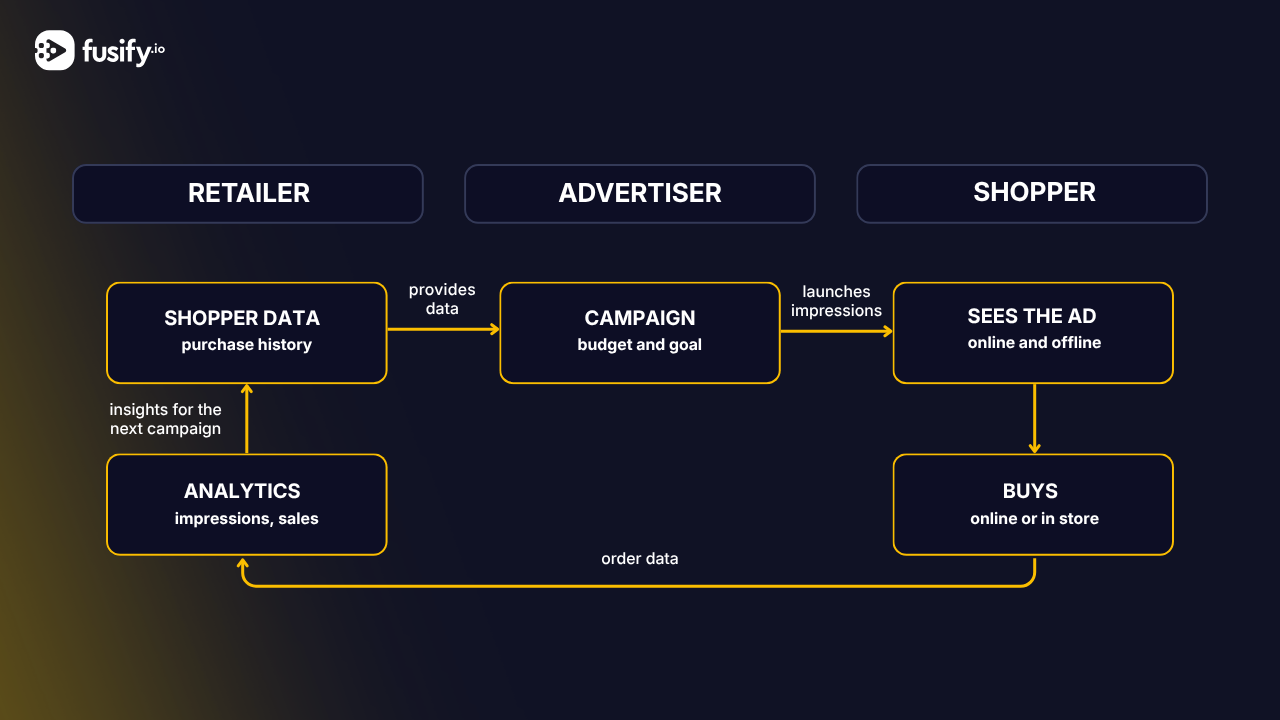
- The retailer builds audience segments
As a retailer, you already know a great deal about how your customers behave. You can see which products they search for and view, what they buy, which categories they return to, and how often they interact with your store. These signals can be used to create audience segments for relevant advertising campaigns.
Advertisers do not need access to customers’ personal data. They reach the required audience through the retailer’s advertising tools.
As with other forms of digital advertising, the system works with identifiers rather than customer names. Each identifier is associated with the relevant audience segments. We explain this in more detail in our article, “Advertising Identifiers: How Digital Advertising Knows What to Show to Whom.”
- The brand selects formats and placements
Ads can appear in an online store’s search results, on product pages, in CRM communications, or on digital screens inside a physical store.
The right format depends on where the audience is and how people interact with the brand at that point in their buying journey.
- The shopper interacts with the ad
The shopper sees the ad and can then visit the product page, make a purchase, or simply ignore it.
- The retailer connects ad exposure to purchases
One of Retail Media’s main advantages is the ability to connect advertising activity with actual purchases. Brands can see how a campaign affected sales: how many people purchased after seeing an ad, how sales changed for specific products or categories, and which formats produced the strongest results.
- Campaign results inform the next campaign
The resulting data can be used to improve future campaigns by adjusting audiences, creatives, channels, or budgets. Over time, brands gain a clearer picture of what works best for their products and customers.
Why Retail Media Creates Value for Everyone Involved
Retail Media addresses a different need for each participant. Retailers gain an additional revenue stream, brands gain access to valuable audiences, and publishers gain additional advertising demand.
For retailers
You monetize assets you already have: traffic, customer relationships, purchase data, in-store advertising space, and other owned channels. When structured properly, Retail Media can become a separate business line in its own right.
Retailers can:
- generate more revenue from existing channels without having to acquire additional traffic;
- monetize first-party data by using customer behavior and purchase history for advertising targeting;
- build longer-term relationships with brands by offering access to defined audiences and measurable results rather than simply selling individual placements.
For advertisers
Brands gain access to an audience the retailer already understands well. Instead of relying mainly on broad demographic targeting, advertisers can work with actual consumer behavior: what people search for, view, and buy. This gives campaigns much greater precision and can improve the likelihood of conversion. According to McKinsey, some Retail Media channels and formats can deliver 3-5x higher ROAS than traditional advertising channels.
Brands can:
- advertise directly in the environment where purchases happen, whether online or in a physical store;
- combine several formats within one campaign and reach shoppers at different stages of product consideration;
- measure sales alongside advertising activity by connecting campaigns with actual purchases;
- build a stronger base of insights for future campaigns and adjust placements based on real results.
For publishers
Online publishers become particularly important when Retail Media extends beyond a retailer’s owned channels. They provide the external inventory used for off-site campaigns, helping brands reach retail audiences elsewhere on the web.
For publishers, Retail Media can:
- bring in additional advertising demand from brands;
- create another way to monetize their advertising inventory through off-site Retail Media campaigns.
What Is a Retail Media Platform?
A Retail Media Platform is the technology layer that connects retailer data, audiences, advertising inventory, campaign management, and analytics. In other words, Retail Media is the business model, the platform is the technology used to run it.
From an advertiser’s perspective, the interface may look much like any other ad platform: select an audience, choose a format, set a budget and campaign period, and launch. Behind that interface, however, is a much more complex system. It receives data from multiple sources, identifies available inventory, delivers ads to the right channels, collects campaign results, and, where the necessary data is available, connects ad exposure with subsequent purchases.
The key components are outlined below:
It is important to understand that the technology setup is different for every retailer. Data sources, CRM platforms, loyalty systems, advertising formats, sales tracking methods, and integration requirements all vary. A ready-made product therefore cannot simply be connected to any retail network without adaptation.
Building the entire system in-house is possible, but in practice it means creating your own AdTech product. You need to develop an advertising platform, integrate it with internal systems, and maintain the infrastructure over time. This raises the cost of implementation and can significantly delay time to market.
For most retailers, working with a technology partner is the more practical option. The partner provides the underlying advertising technology and adapts it to the retailer’s existing infrastructure. This shortens the path to launch without requiring the retailer to build an advertising platform from scratch.
Retail Media with Fusify
Whichever model you choose, Retail Media still requires integrations with advertising infrastructure, audience data, and analytics systems. Here is what that technology stack looks like at Fusify.
The Fusify platform processes around 300 billion ad requests and more than 1,000 campaigns every month. Advertisers use the platform across Ukraine, Turkey, and Brazil.
What do you get?
- Advertisers. Access to a pool of brands interested in working with retailers.
- Targeting. 700+ IAB categories, ready-made and custom audience segments, remarketing, and look-alike targeting.
- Ad formats. Rich Media and other digital advertising solutions.
- Viewability control. Smart Impressions counts an impression only when the ad actually enters the visible area of the screen. Average viewability for banner formats exceeds 80%, compared with a market average of 33%.
- Attribution. Fusify Pixel tracks post-click and post-view conversions, helping advertisers understand what happens after someone sees or interacts with an ad.
- Reporting. More than 30 metrics, data refreshed every five minutes, CSV and XLSX exports, and an API for integration with internal systems.
Learn how to launch Retail Media using Fusify’s existing advertising infrastructure.
Conclusion
Retail Media can be launched at different levels of complexity, from monetizing a portion of existing advertising inventory to building a full-scale operation with proprietary audience segments and off-site campaigns.
Retailers do not need to develop all of the underlying advertising technology themselves. A Retail Media Platform can be adapted to existing infrastructure together with a technology partner.

.png)

.png)


.webp)
.webp)
.webp)
.webp)


.webp)

.webp)
.webp)

.webp)
.webp)

.webp)

.webp)

