.svg)






Myths About In-App: How Advertising Works in Mobile Apps and Who Actually Sees It
In-app advertising still feels a bit suspicious to many agencies and brands. It seems familiar in logic, yet somehow plays by its “own rules.”

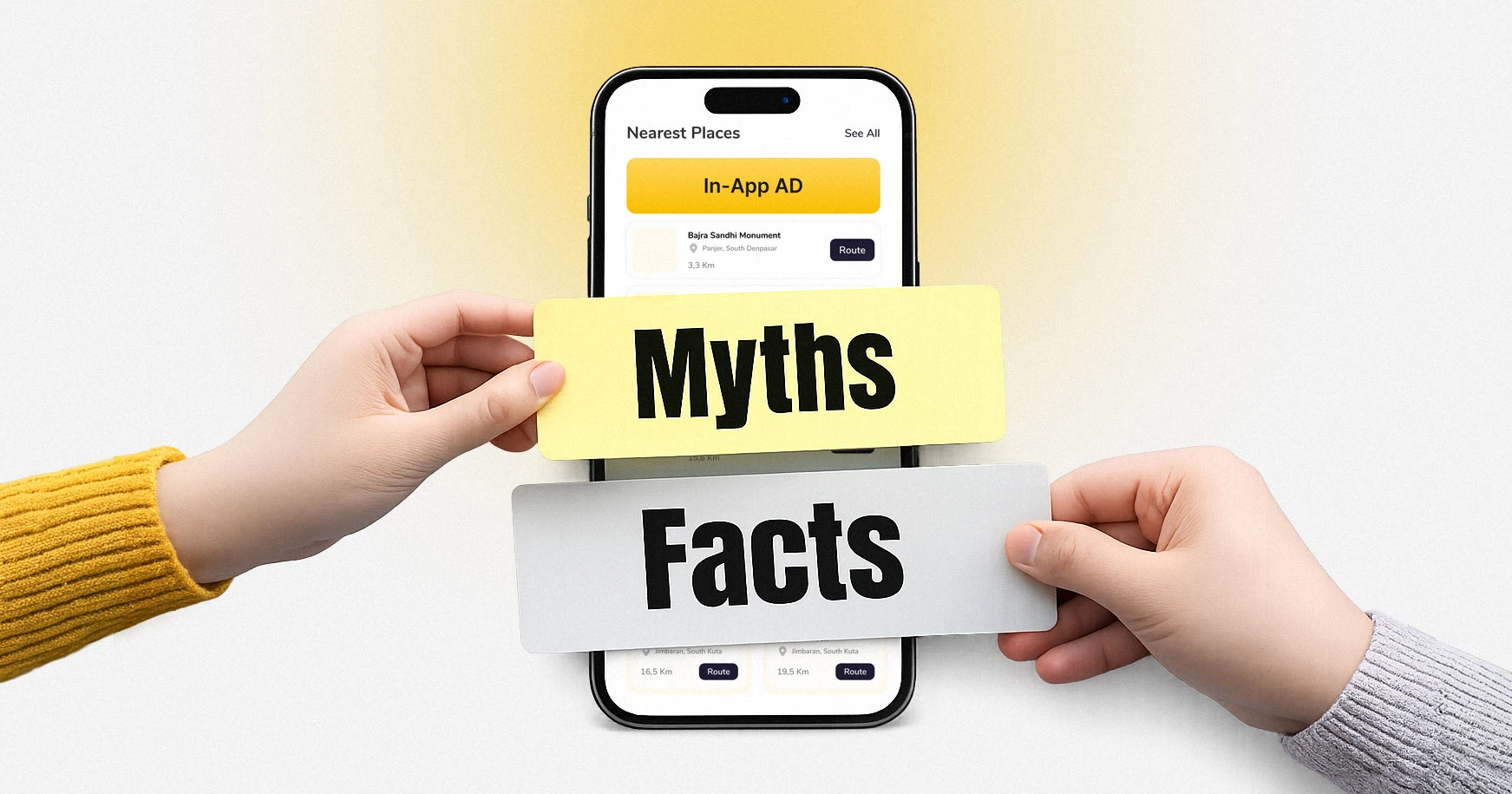
In-app advertising still feels a bit suspicious to many agencies and brands. It seems familiar in logic, yet somehow plays by its “own rules.” This channel is often postponed: first web, then video, and we’ll deal with apps later. And the reason is almost always the same — a sense that everything inside apps is more complex, less predictable, and requires separate expertise.
The paradox, however, is that in-app is probably the least “exotic” channel among those brands use today.
TL;DR
- In-app advertising runs on the same OpenRTB auction as web.
- The app doesn’t choose the ad — only the moment it appears.
- All targeting logic exists outside the app.
- Web creatives usually work without changes.
- Metrics are standard: impressions, reach, frequency.
- The app audience is broader and more affluent than it seems.
What is in-app advertising
In-app inventory is programmatic advertising inside mobile applications, where the app itself only creates an opportunity for an impression, while ad decisions are made by external platforms through an auction based on user data.
Simply put, these are ad impressions inside mobile apps sold through the programmatic ecosystem using the same logic as web inventory.
Historical cycles
Interestingly, this isn’t the first time the market has reacted this way to a new type of inventory.
A similar story happened with mobile web back in 2016. When mobile web traffic started growing rapidly, many advertisers simply turned it off. Not because it didn’t work, but because it was harder to measure with familiar tools.
At one point, it looked absurd: mobile web audiences already accounted for over a third — sometimes even half — of total traffic, yet budgets weren’t following. The reason was the lack of familiar metrics and trust in them.
Today, in-app is going through a similar phase. The same questions arise about measurement, mechanics, and the “complexity” of the environment.
And behind them, as usual, are the same myths.
Myth N1: “Only kids hang out in apps”
This is one of the strongest barriers still influencing brand decisions. According to the PubMatic Brand & Mobile Gaming study, 70% of marketers in APAC already use in-app advertising, but only 52% run ads specifically in games. The main reason lies in stereotypes: many brands still believe gaming audiences don’t match their values or consist mostly of young men, while in reality this is a much broader and more affluent audience.
If you look at how people actually use their phones, this myth quickly falls apart.
Users don’t live separately in an “app world” and a “web world.” It’s the same person switching between formats throughout the day: reading news, using banking apps, watching videos, playing games.
Gaming audiences are no longer just kids (well, not exclusively). Many have a clearly defined profile: men and women aged 25–44, users with regular in-app spending, people with specific interests.
In many cases, this audience is even more predictable than web users. Yet the market continues to underestimate it — largely out of inertia and a lack of understanding of who exactly sees the ads and how.
Let’s break it down.
What an ad impression looks like from the inside
If simplified, an app does just one thing: it determines the moment when an ad should appear.
- This could be:
- the end of a game level;
- a transition between screens;
- an attempt to claim a bonus;
- any other logical point within the user flow.
At that point, its role is essentially over. The app does not analyze the user or choose the ad. It simply signals: “there’s space for an ad now” and sends a request.
What happens after the request
This is where things become very familiar to anyone working with programmatic. The SDK (software development kit — a technical module embedded in the app responsible for ad delivery) sends a request with basic data: user ID, app information, sometimes geo. At this stage, there’s no complex logic yet.
Then the request goes to the SSP, where it may be enriched with data, and then to the DSP.
And that’s where the key process happens:
- The system evaluates what it knows about the user;
- matches this data with active campaigns;
- places a bid;
- the highest bid wins.
After that, the ad is returned to the app and shown to the user.
Important: all this logic exists outside the app. The app itself is merely an entry point in the process.
Myth N2: “In-app has its own hidden ad logic”
This is another common fear — that you’ll need to deal with something fundamentally new. In reality, it’s the opposite. Under the hood, it’s the same OpenRTB auction. The only difference is technical implementation: on the web, inventory is served via JavaScript, while in apps it’s handled by the SDK.
But the principle is identical:
The DSP receives a request → evaluates the user → places a bid → the highest bid wins. There is no separate “in-app logic.”
Myth N3: “Metrics can’t be measured”
As mentioned earlier, this bias dates back to the mobile web era. Back then, the fastest-growing segment of traffic was often turned off — not because it didn’t work, but because it wasn’t properly measurable.
The situation with in-app is similar. But at its core, everything works the same:
- impressions are tracked;
- reach is available;
- frequency is controlled.
For advertising campaigns, especially those focused on awareness, this is more than enough.

Who actually decides which ad is shown
Many clients just starting to explore the world of in-app have an intuitive feeling that each app collects and stores user data and then serves it like a black box. In reality, apps know very little about users.
They don’t know you searched for a car.
They don’t know you clicked on an ad yesterday.
They don’t know you spend money in other apps.
But external systems do.
These systems build the user profile and decide which ad to show. That’s why ads in a game are tied not to the game itself, but to the person — someone who has already left a significant digital footprint. The app’s influence on advertising is limited to:
- the number of ad placements;
- frequency caps;
- minimum price;
- blocklists of advertisers.
Everything else is determined by the auction, and most inventory is sold programmatically rather than directly.
Myth N4: “Brand safety is harder to control in in-app”
Another common concern is that it’s harder to control where ads appear in apps. At first glance, the logic seems clear: less transparency, a different environment, no familiar content context like on the web.
But in practice, it often works the other way around.
On the web, the main “risk” comes from the content itself. It changes constantly and isn’t always predictable: a neutral article today may be surrounded by sensitive topics or breaking news tomorrow, creating potential brand risks.
In apps, the environment is much more stable. A game remains a game. If it’s a puzzle, it won’t suddenly turn into a news story or crisis content. App categories are usually clear and don’t change dynamically.
That’s why control often comes down to simple decisions:
- exclude certain categories (e.g., shooters);
- focus on safe genres (casual games, puzzles);
- work within clearly defined themes.
As a result, in-app often provides a more predictable and controlled environment than the web.
Myth N5: “It’s hard for brands to choose which apps to buy”
Many believe advertisers choose specific games or apps as if picking items off a shelf. In reality, brands buy audiences, not app titles or covers.
In this case, apps are just context: they define where an ad appears, not who sees it. That’s why in-app scales so well — you work not with individual placements but with the audience itself.
Moreover, today’s socio-demographic profiles are determined with high accuracy. DSP platforms rely on international research, large volumes of behavioral data, and AI algorithms that can identify audience cores by gender, age, and behavior patterns with high probability.
Simply put: the game is the stage, and the player (user) is the main viewer you want to reach.
Conclusion
In-app advertising seems complex until you break it down into simple parts. The app is responsible only for the moment of the impression; everything else is handled by the market and technology. Most importantly, this isn’t a new chaotic system with its own rules — it’s proven programmatic that has simply moved to where real users are today.
You control impressions, keep your metrics, use the same creatives — and get a real, measurable result. And most importantly, in-app is where one of the most active and solvent audiences lives today: people who are used to spending time in mobile environments, interacting with services, and making purchase decisions in just a few taps.

.png)

.png)
.png)




.webp)
.webp)
.webp)
.webp)


.webp)

.webp)
.webp)

.webp)
.webp)

.webp)

.webp)

